ELASTIC3S
The Project
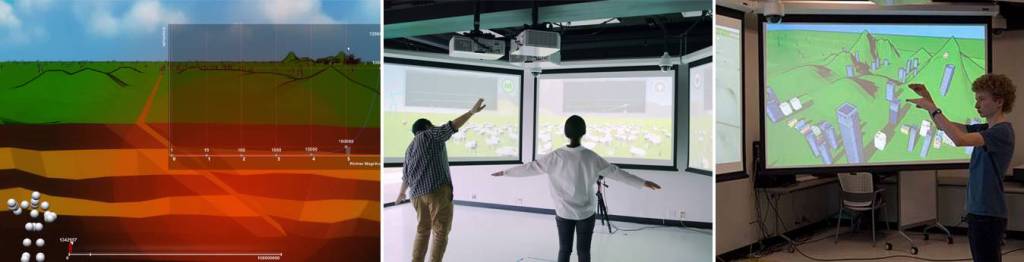
ELASTIC3S (Embodied Learning Augmented through Simulation Theaters for Interacting with Cross-Cutting Concepts in Science) is an NSF Cyberlearning research project conducted by an interdisciplinary team of learning scientists and computer scientists at the University of Illinois at Urbana-Champaign. The goal of this project is explore ways that body movement can be used to enhance learning of “big ideas” in science. We are developing new techniques for tracking and recognizing the hand and body movements of K12 learners so that they can interact in expressive ways with simulations from a range of topic areas in geology, chemistry, biology, etc. We are conducting interviews with high school students in Central Illinois to try and better understand how their gestures and other body actions facilitate reasoning with the cross-cutting concepts outlined in the Next Generation Science Standards, and we are integrating these findings into the design of immersive “simulation theaters” that embed learners within important science phenomena.
My role
- GESTURE RESEARCH
- Assessment design
- interview design
- data collection
- Data analysis
- publications
In this project, I led the initial designs of the simulations and the interview protocols. These interviews helped us design appropriate gestures into the larger simulations. These preliminary studies are published in the papers listed below.
Below I share one study that I published with my colleagues identifying gestures that supported students’ learning about exponential growth.
Research Question
- How do students use gestures when reasoning about mathematical growth concepts, and
- What role do these movements play in their understanding?
Context
We investigated how middle school students use hand movements when solving problems involving different types of growth (linear vs. exponential), with a focus on whether certain gestures help students reason more accurately.
Data Collection
We interviewed 15 middle school students using problem-solving tasks that involved understanding growth concepts. Students worked on several mathematical challenges, including a modified “rice on chessboard” problem that demonstrates exponential growth.
Analysis
We carefully documented and categorized all gesture types used by students, then analyzed how these movements aligned with their verbal explanations. Statistical tests were conducted to determine relationships between gesture types and accuracy of understanding.

Key Findings
- Two types of gestures emerged: concrete (physically representing quantities) and symbolic (representing abstract mathematical operations)
- Significant relationship discovered: Students using concrete gestures showed more accurate mathematical reasoning about growth
- Statistical evidence: Statistical tests confirmed that concrete gestures were significantly associated with correct reasoning (p < .05)
Implications
This research suggests that encouraging specific types of hand movements may improve students’ understanding of complex mathematical concepts, with potential applications for educational technology design.
 Nitasha Mathayas, PH.D.