
TEA
The Project
This project examined ways teachers empower students to take charge of their own science learning. Supporting students’ epistemic agency — having students take ownership over the intellectual work of doing science and making decisions about how that work should proceed — is a very complex task. Through interviews with teachers about their change process, I explored how teachers’ actions can transform students from passive learners into active scientific investigators who make their own decisions about how to explore and understand the world around them.
My role
- project Manager
- Data Analysis
- interviews
- PUBLICATIONS
In this project, I led the data collection and processing, managing methodological rigor when working with expert science teachers. I also collaborated with the team to generate intellectual contributions about what it means to support students’ epistemic agency.
Theoretical grounding
Two major theories guided my thinking about how teachers learn to support student agency:
- Teacher noticing: what do teachers notice in the moment, how do they interpret it, and how do they respond (Sherin et al., 2011; Krist et al., 2023)
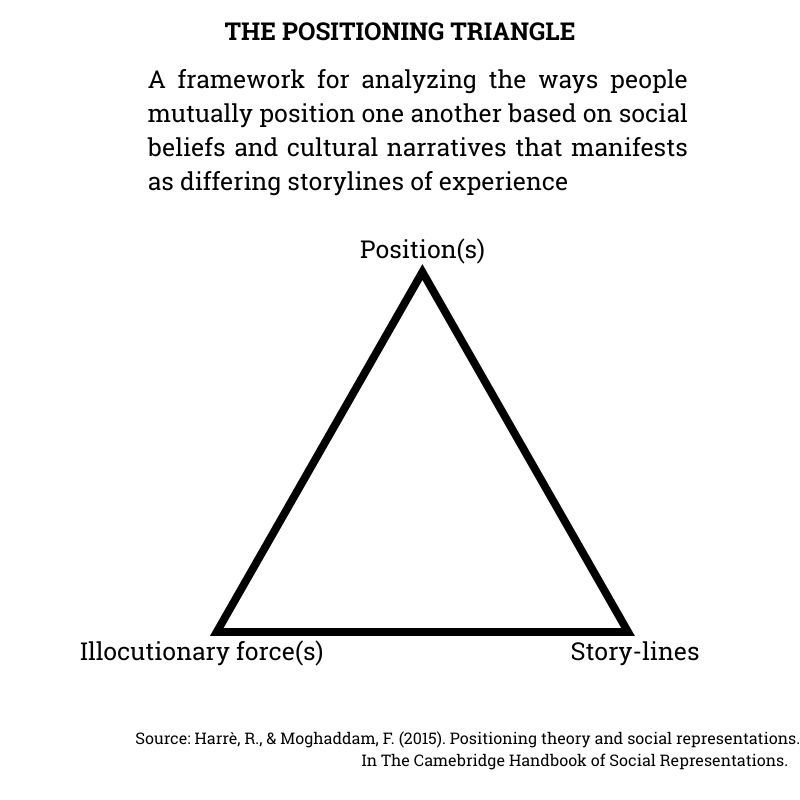
- Social positioning theory: Positioning Theory looks at how people’s roles and responsibilities in everyday interactions are shaped by unspoken social rules. It examines how our shared understanding of ‘right’ and ‘wrong’ behavior influences the way we interact with each other (Langenhove & Harré, 1999)
Research Questions
The following questions were part of a study I presented at the Annual Conference of the National Association for Reserach in Science Teaching in 2021.
- Why and how does a science teacher open up space to position students with epistemic agency across a conceptually contiguous series of lessons?
- How does the teacher-student dialogue shift across this series of lessons?
Methods
To understand what teachers notice in the classroom, we used GoProTM cameras to capture the teacher’s point-of-view (POV) in the classroom.
They used smart remotes to tag classroom moments-of-interest.
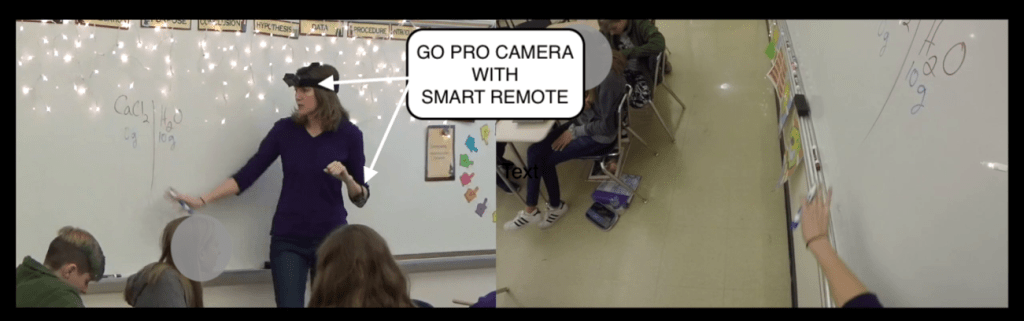
Then at the end of that class, we conducted stimulated-recall interviews with them in which we would show them a few seconds of the moment they tagged and they shared their thinking of that moment.
This novel point-of-view (POV) methodology gave us insight into their thinking in the moment and what they were learning about their teaching process from it.

Analysis
I conducted case studies of expert teachers to explore their thinking of their classrooms. The particular case sudy of Samantha (a pseudonym) logged 14 tagged moments from Go-Pro and interviews over the course of one science unit that ran for 12 weeks. I reviewed her interviews from before and after the unit to understand her conceptualization of epistemic agency.
I then examined the 14 tagged moments from her classroom teaching to identify which moments exemplified her conceptualization of epistemic agency. I found 3 episodes.
Those three episodes were transcribed and then I conducted a discourse analysis using two schemes to answer the research questions
- I applied the “Grammar of Agency” coding scheme by Martin (2016) to examine how Samantha positioned her students with epistemic agency using language
- Then across the episodes I applied the “Dynamic Moves” coding scheme by González & DeJarnette (2015) to identify patterns in her instructional moves
To establish trustworthiness of insights around Samantha’s case, I conducted multiple reviews with the research lead and gained peer feedback about insights from expert science teachers and research team members helping refine my analysis.
Findings
Samantha was driven by four main goals when she chose to make space for her students to drive the science learning. The image shows those goals and how they were represented in her interview


In the classroom, Samantha subtly indexed students to take intellectural responsibility for the science work by positioning them with her words. The tanscript in the adjacent figure demonstrates how she invited students to speak up and then positioning other students to provide peer feedback.

Over the course of three contiguous classroom lessons,Samantha’s talk moves supported students to take more intellectual ownership of the scientific sensemaking in the classroom. These efforts culminated in a long and complex debate among the students discussing the pros and cons of different heating materials to be used in an incubator.
Implications and Recommendations
- Samantha’s repositioning moves to direct evaluation of response to students emerged dynamically as a response to meeting her vision for her students
- Her consistent efforts to position students with responsibility took three lessons before more students visibly participated in scientific talk
- The POV video recording followed by stimulated recall interview method facilitated Samantha’s reflective practice, enhancing her focus on her vision and supporting her to improve her pedagogy
 Nitasha Mathayas, PH.D.