
CS4DE
The Project
Computer Science for Delaware (CS4DE) was a Research Practice Partnership that ran between 2020-2024 between University of Delaware and the Delaware Department of Education. The project goals were to provide professional development (PD) to K-5 teachers and instructional staff on integrating computational thinking (CT) skills and culturally relevant pedagogy (CRP) into elementary instruction.
This project addressed the growing need for a STEM and technology workforce in the US while addressing the issues of racial and gender disparities currently present in the field. Targeting elementary grades was also necessary to draw the interest of students from underrepresented populations in CS into the field.
My role
- Research Manager
- PD Workshop Developer
- Data Analysis
- Publications
- Proposal Development
In this project, I investigated how outcomes from the professional development program offered intellectual and practical implications for teaching computer science in elementary grades.
Theoretical grounding
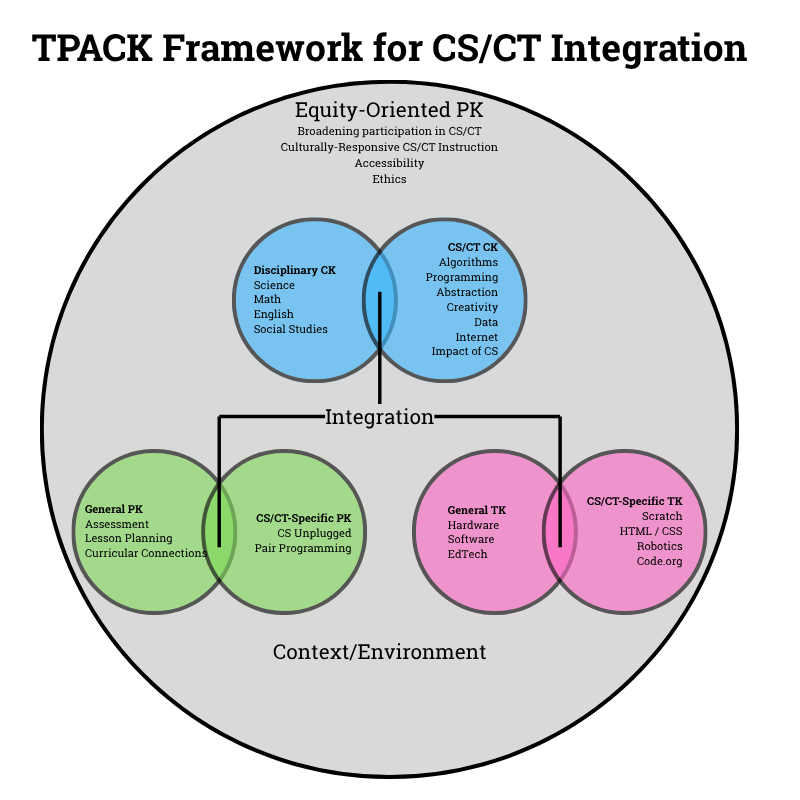
- The study was grouded in the Technological Pedagogical Content Knowledge (TPACK) framework which identifies the knowledge teachers need to effectively integrate CS/CT concepts, tools, and methods with subject matter and teaching strategies to achieve meaningful learning outcomes within specific educational settings.
- The framework on the right foregrounds the equity and contextual influences in the CS field by offering clearer definitions of CS/CT integrated instruction while emphasizing equity and contextual factors.
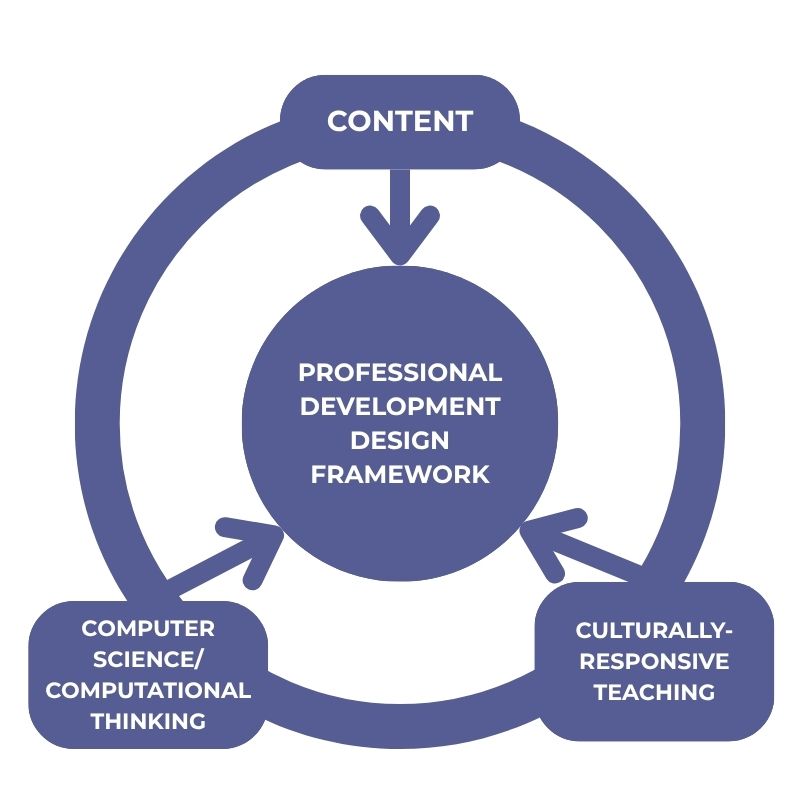
- Accordingly, the summer institute was designed on this framework and shown to teachers as the 3Cs: content, CS/CT, and CRP
Research Questions
The the following questions were part of a study I presented at the Annual Conference of th the American Educational Research Association in 2025.
- How do upper elementary (grades 3-5) students’ attitudes toward coding shift after engaging in CT-integrated lessons delivered by their teachers?
- What attitudes and beliefs do K-5 students hold toward coding after the CT-integrated lessons were delivered by their teachers?
- What considerations did they raise about pursuing coding instruction in the future?
- What components of the CT-integrated lessons-such as CT-tools, lesson activities, content, and teacher’s instructional approach-did students like or not like?
Data Collection
June 2022-23 cycle of the project was the first year of in-person institute attendance. 27 elementary grade educators attended and
7 teachers participated in this research study.
The team interviewed and collected these teacher’s lesson plans after the end of the institute. During the 2022 academic year, we collected data from their students in two formats:
- Post lesson Interviews with 58 students
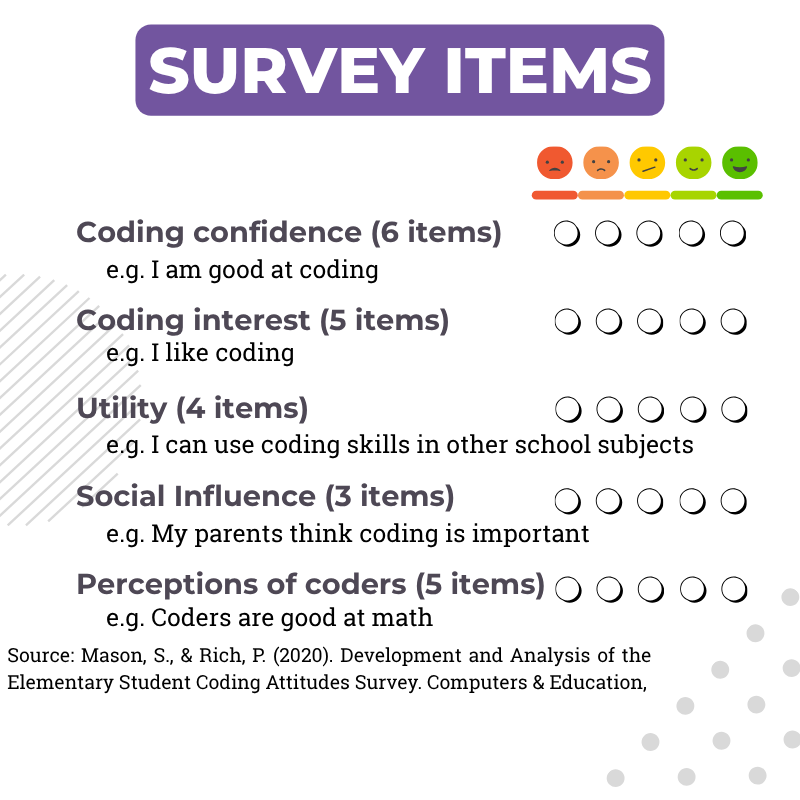
- Pre and post lesson survey with 141 students
Images on the right depict sample interview questions and survey items used.

Mixed Methods Data Analysis
Interview Analysis process
- Interviews transcribed verbatim
- Data Analysis Software: Dedoose
- Iterative coding process (Miles & Huberman, 2014)
- Deductive coding by interview question
- Inductive coding by interests and attitudes
- Axial coding while referencing lesson plans, and classroom artefacts
Survey Analysis process
- Conducted Confirmatory Factor Analysis to check that data fit with the survey factors
- Factor loadings of two survey items were low and removed
- I am good at problem solving (0.36-0.42)
- Kids who code enjoy doing sports (0.38-0.4)
- Conducted Independent samples t-test to check for overal changes across factors
- Conducted MANOVA to explore differences by grade, gender, and coding experience
Synthesis analysis process
- Conducted multiple peer debrief sessions with project team members about findings
- Shared insights at conference and obtained feedback
- Revised analysis and insights
Findings
- Interviews revealed widespread student interest in future coding opportunities and positive reactions to the lessons, but there are nuances to which aspects of the lessons they liked
- Survey results showed no significant changes in most items and a lower interest post-lesson
- Results from independent samples t test show that mean ratings on 2 out of 5 factors were lower at posttest than at pretest.
- Although students’ attitudes across gender remained stable, female students scored lower than males in multiple measures.
- MANOVA insights –
- Girls have lower ratings than boys in all constructs but coding confidence
- Students with more than 1 year experience coding rated higher confidence than those with less than a year of coding experience
- MANOVA insights –
Student attitudes
The chart shows that students were had largely positive sentiments towards coding lessons with 98% of interviewees stating that their teacher should teach the lesson again.
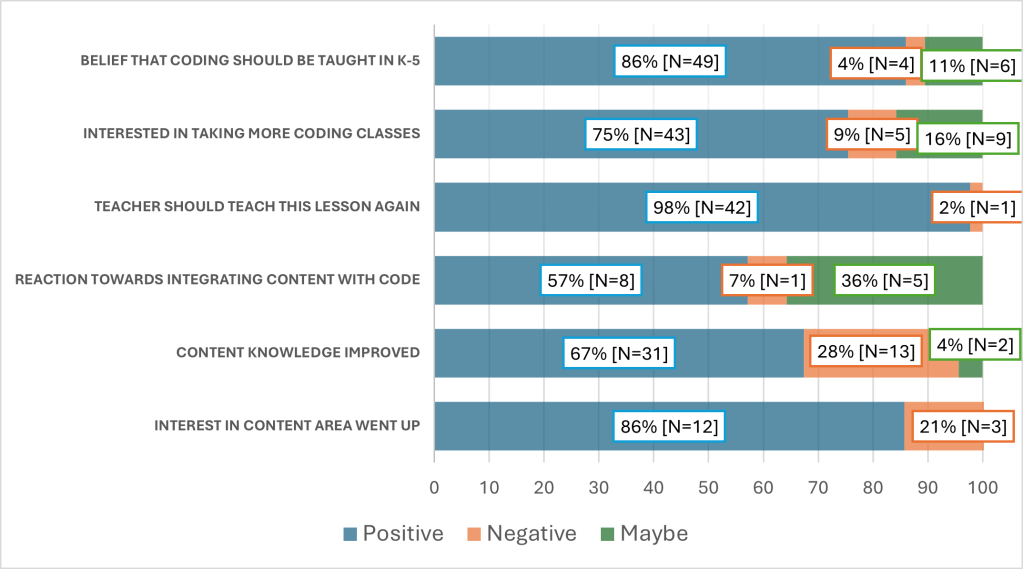
Interviews show that students’ reasons for interest in coding emerged from their broader societal understanding of the significant of coding and its connection to tech jobs. For instance, S2’s interests leaned towards technology but S8’s did not, making them belive that coding was not for them despite them being expressing confidence in the skill

Likes and Dislikes
Students’ responses demonstrate a promising trend in support of CT-integrated lessons. Figure 1 shows the number of unique responses across all aspects of the lessons that students liked and disliked. Overall, 55 students answered what they liked with some students mentioning more than one aspect. The top three aspects that students liked included: (a) it was fun, (b) they got to create a product, and (c) they liked using certain features of the CT tools such as the music and lights in Scratch or Sphero BOLT.
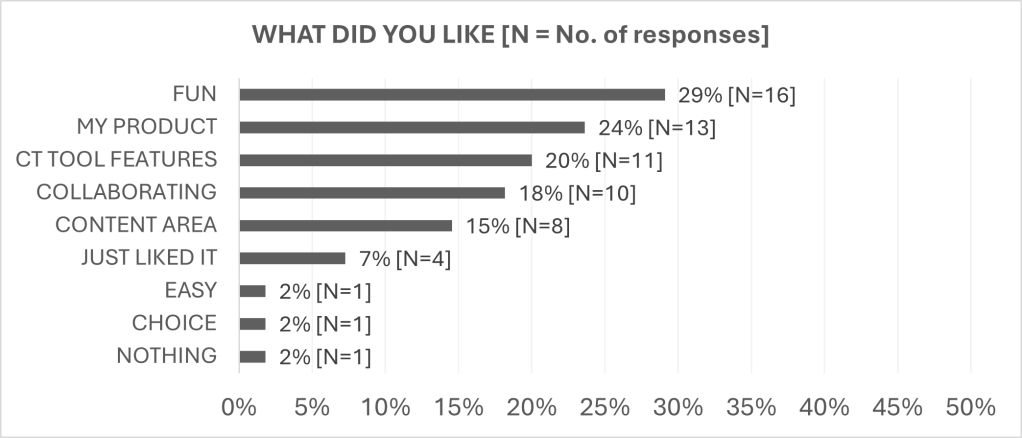

The top three aspects that students liked included: (a) it was fun, (b) they got to create a product, and (c) they liked using certain features of the CT tools such as the music and lights in Scratch or Sphero BOLT. , 45 students responded and the top three dislikes were: (a) nothing, which meant they didn’t dislike anything specific about the lesson; (b) the lesson was boring; and (c) it was hard. Three students didn’t like certain characteristics of Scratch

Conclusions
Goal of this study was to explore student outcomes from teacher PD of CT and CRP integrated instruction
- Interviews provided greater insight into student’s views of the lessons, essentially, the creative and collaborative aspects of lessons were engaging, but some user interfaces of the tools were occasional pain points.
- Detailed analysis showed that students were motivated to pursue coding due to knowledge of careers in technology, however they were not aware of its presence in arts, entertainment, or non-tech jobs.
- The Elementary Student Coding Attitudes Survey did not show significant changes in student coding interests
- Scope of our study might have been too small to capture differences
- Need for development of a more sensitive instrument for elementary students’ interests
Implications and Recommendations
- CT integrated instruction is fun and engaging to elementary kids and elementary educators should consider incorporating CT into their instruction in any form to get started on this path
- Teachers should integrate CS careers into their lessons and help students see how CT is involved in non-technological jobs.
- CS researchers need to develop more sensitive instruments to capture elementary students’ CS and CT interests
<< Back
GEMSTEP >>

